
11 March 2026
The Evidence-Based Guide to Candidate Attraction
Why Your Best Candidates Are Hesitating
When you run a startup or a scaleup, your biggest obstacle to talent acquisition is the information gap. You know your company has a great culture and big goals, but a candidate looking at your website and social media profiles does not. This is what economists call information asymmetry (Akerlof, 1970). What it means is that you have all the "inside" info and the candidate is left guessing.
To bridge this gap, candidates look for clues or signals to decide if your company is actually a good place to work and if they should apply (Connelly et al., 2011). These signals come from job descriptions, messages, social media or during interactions with your recruiters, hiring managers and employees. Applicants interpret the small bits of information they have to form a big picture of what it is actually like to work for you. Because where someone works is a huge part of their identity, they pay very close attention to the "vibe" or impression they get from your brand before they ever hit apply (Cable & Turban, 2001).

Ultimately, the ability to attract high-quality applicants is a primary driver of your company's success and long-term value (Rynes & Barber, 1990). Here is how you can use proven, evidence-based strategies to send the right signals and attract the diverse, high-performing team you need.
Designing Job Ads
Benefits:
Automated Pre-Selection: A generic ad is a magnet for "spray and pray" applicants. By acting as a sorting tool, your ad does part of the heavy lifting for you. It attracts the high-fit talent way better while making the low-fit candidates realize on their own that they won't thrive in your specific environment. This saves you and your team dozens of hours in screening calls.
Reduced Candidate Risk: For top-tier talent, moving to a startup is a risk. Familiarity may be the antidote to that risk. Research shows that familiarity leads to higher ratings of attractiveness. If they understand how you work (e.g., your sprint cycles, your decision-making, your technical hurdles), they could feel safe enough to leave their stable corporate job for your venture.
Faster Integration: When a candidate enters your firm with a high degree of familiarity, their "ramp-up" period is shorter. They aren't surprised by your culture because you described it accurately in the ad. This means they reach full productivity weeks earlier than a "blind" hire.
Increased Qualified Applicant Pool: Replace vague superlatives with objective requirements to bypass the confidence gap and increase your qualified applicant pool by 7% (Abraham & Stein, 2004).
Higher Engagement: Providing a higher volume of information directly increases the probability that a qualified applicant will respond.
Standing Out: In a market flooded with “fast-paced” startups, the founder who provides exact details makes you appear more professional, desirable, and credible (Behling, Labovitz, and Gainer, 1968). Moreover, it allows a candidate to perform a complex evaluation which leads to positive applicant reactions (Roberson, Collins, & Oreg, 2005).
Strategic Diversity: By focusing on benefits, career trajectory, and technical challenge, you can also become more effective at recruiting women and candidates of color. Reframing the job as a chance to change the system increases application rates from younger applicants (Linos, 2018; Sciepura & Linos, 2020).
Reduced Time-to-Hire: Using scarcity signals and prestige markers attract more ambitious talent, justify higher expectations and force candidates to act quickly.
A job advertisement is one of the very first signal a candidate receives. If your ad is too generic, it fails to distinguish you from competitors. To attract a diverse and high quality pool, your ad should act as a reliable sorting tool that helps the right people identify themselves while discouraging those who do not fit (Connelly et al., 2011).
Research by Gatewood, Gowan, and Lautenschlager (1993) shows that when candidates feel familiar with how your organization actually works, they respond much more positively. Turban et al. (2001) took this further, proving that when a candidate feels they "know" your company, they automatically rate it as more attractive. Your ad is your chance to build that familiarity from the first click.

Language: The Power of Objectivity
TL;DR
The Strategy: Replace subjective words (like “excellent” or “world-class”) and optional “nice-to-haves” with objective, fact-based requirements.
The Benefit: You can increase your total applicant pool by 7% across all genders. By switching to facts, you bypass the "confidence gap" where highly qualified but modest candidates opt out because they don't think they are "world-class" enough.
Examples:
The Skill Reframing: Replace "Excellent Python knowledge" with "Ability to write clean Python code”. This encourages anyone who can actually write the code to apply, increasing your qualified applicant count.
The Qualification Reframing: Instead of "Preferred: Experience in high-growth startups," use "Experience working in an environment with bi-weekly deployment cycles and 20% user growth, month-over-month”. This attracts candidates who thrive in fast-moving operations and filters out those used to slow, corporate release schedules.
The Leadership Reframing: Change "Natural-born leader" to "Responsible for mentoring two junior developers and conducting weekly one-on-one performance reviews." This allows you to verify actual leadership experience rather than hiring someone who just "feels" like a leader but has never coached a team.
The Communication Reframing: Move from "World-class communicator" to "Experience presenting monthly technical roadmaps to a board of directors and non-technical stakeholders”. This ensures you hire someone who can translate tech to business, a critical skill for early-stage startups where every hire interacts with stakeholders.
The words you choose act as a filter. Research by Coffman et al. (2019) shows that when job descriptions are objective and fact-based, men and women evaluate their own skills more accurately. This leads to a much more balanced and honest applicant list.
Furthermore, a study by Abraham and Stein (2024) found that removing "preferred qualifications" and vague words like "excellent" or "world-class" actually closes the skill gap. It increases the total number of applications (+7%) from both men (+7%) and women (+5%).
While many employers try to be inclusive and create gender-neutral postings by avoiding masculine or feminine connotations (e.g. words like “assertive” or “cooperative”) analyses by Castilla and Rho (2023) show negligible effects for these tweaks. In practice, efforts to simply change the connotations of words do not matter much for gender equality and diversity compared to hard objectivity.
Before | After | What changed? |
|---|---|---|
"Master’s Degree preferred" | [Removed] | Removed optional qualification. If it’s not a deal-breaker, delete it. |
“Native-level German preferred” | [Removed] | Removed optional qualification. If it’s not a deal-breaker, delete it. |
"Excellent coding skills" | "Coding skills" | Removed adjective. "Excellent" is an opinion; the skill itself is the fact. |
"Outstanding written communication" | "Written communication" | Removed adjective. "Outstanding" is an opinion; the skill itself is the fact. |
"Strong leadership track record" | “Experience managing a team” | Removed adjective. "Strong" is an opinion; the skill itself is the fact. |
"SQL fluency/proficiency" | "Experience with SQL" | Removed subjective intensity. "Fluency" is vague; "Experience" is objective. |
The Specificity
Breaugh and Billings (1988) argued that even when employers try to be realistic, the information is often too general (e.g., "salaries are competitive") to allow for informed decision-making.
TL;DR
The Strategy: Cut the corporate "marketing speak." Give candidates hard data about your technical challenges, where their career is going and the real impact they will have.
The Benefit: Specificity increases the "believability" of your message and encourages engagement, including diverse talent pools (younger candidates, people of color, women). Providing a higher volume of information directly increases the probability that a qualified applicant will respond.
Additionally, you stand out through the Contrast Effect. In a market flooded with “fast-paced” startups, the founder who provides exact details makes you appear more professional, desirable, and credible (Behling, Labovitz, and Gainer, 1968). You attract talent that is motivated by solving specific bottlenecks.
Examples:
Engineering Hook:
Instead of a list of tasks, describe a real problem. For example: You will be responsible for reducing our API latency from 200ms to 50ms using Go and Redis.
Be task-specific: instead of saying "You will code in X" use: You will be responsible for refactoring our legacy authentication module into a Go-based service that handles 10,000 concurrent logins.
Vision Hook:
Reframe the role as a chance to innovate to increase younger, purpose-driven talent. For example: Join us to rebuild how the Swiss banking sector handles cross-border payments.
Operational Hook:
Be clear about the next 12 months of growth. For example: In this role, you will start by managing one project and move into a Lead Architect position as we scale our engineering team.
Detail your operational reality. For example: Include a full list of the team’s current tech stack, their sprint cycle (e.g., 2-week Scrum), and their primary communication tools (e.g., Slack and Jira).
Replace "Competitive salary" with hard numbers and growth triggers. For example: We offer a starting salary of 125.000 CHF/EUR with a structured 5% increase after your first successful production deployment.
Focus on the specific perks that reduce friction in a candidate's life. For example: We offer 100% remote work flexibility, a 5,000 CHF annual learning budget, and a structured mentorship program for every new hire.
By replacing vague sentences with operational data, you provide the "vividness" required for a candidate to perform a complex evaluation of your environment (Roberson et al., 2005):
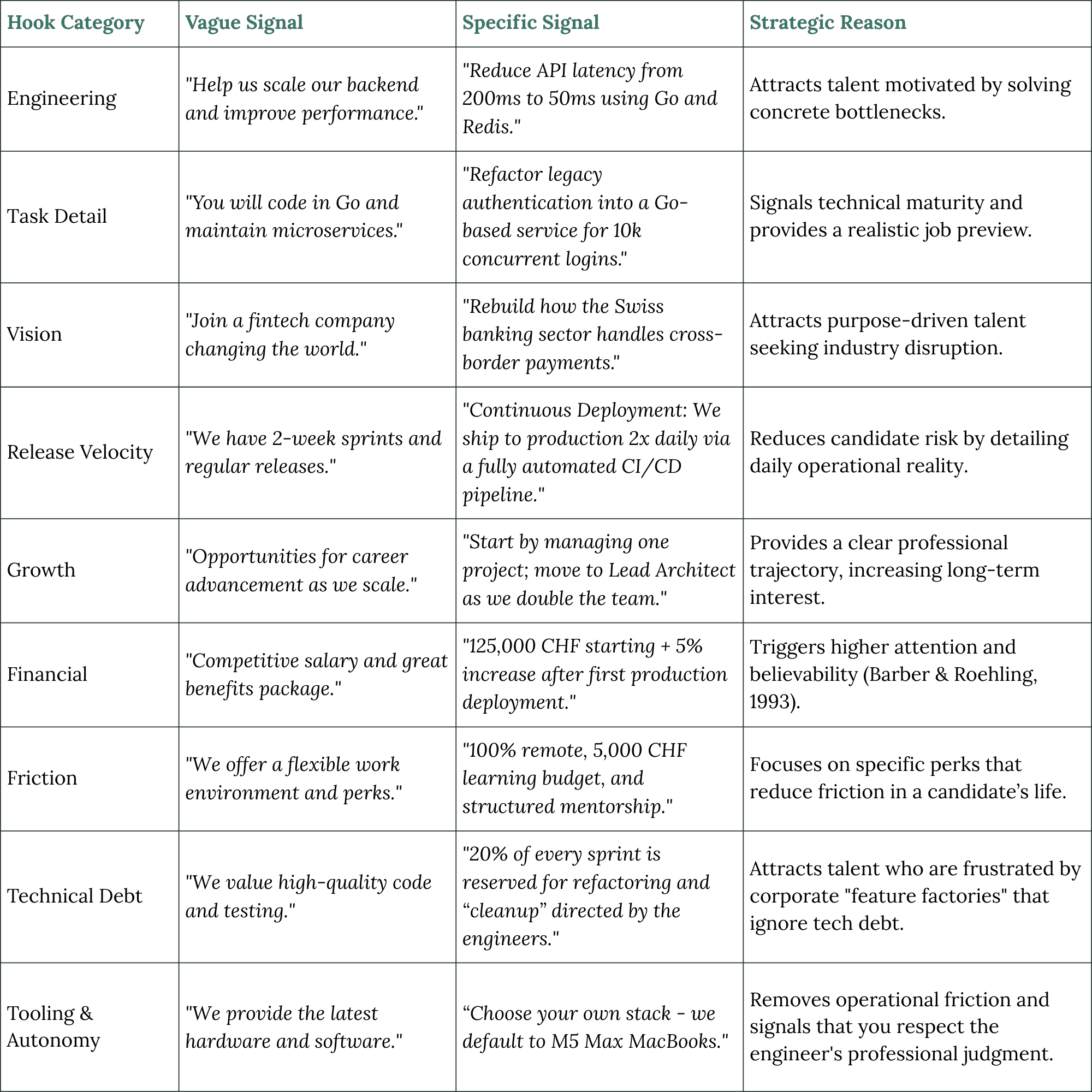
When a job ad is general, candidates have to guess what you are like. In research terms, they rely on inferences (Rossiter, 1981). Think of it like a blurry photo. But when you are specific, you provide a high-definition image. This allows a candidate to perform a complex evaluation which leads to positive applicant reactions (Roberson, Collins, & Oreg, 2005). They stop wondering if you are "cool" and start figuring out if they can actually solve your problems.
Research suggests that specific claims are more persuasive because they enhance message vividness and lead to greater cognitive elaboration (Kisielius and Sternthal, 1984; Johnson and Kisielius, 1985). When a message is explicit, it requires less cognitive effort for the candidate to understand (Bettman et al., 1998). In contrast, decreasing specificity detracts from claim believability and increases negative attitudes toward both the message and your company (Snyder, 1989).
Research has demonstrated the positive effects of comprehensive message content, especially in the early stages of a job search (Franke, Huhmann, and Mothersbaugh, 2004). Studies in advertising also support the effectiveness of including task-specific information (Fernandez and Rosen, 2000). Gatewood, Gowan, and Lautenschlager (1993) found a positive correlation between the total amount of information in an advertisement and the probability of an applicant responding. Simply put, providing more data increases your chances of getting a reply.
Furthermore, Barber and Roehling (1993) confirmed that participants pay more attention to attributes when specific information is provided (such as an exact salary) compared to vague information.

By focusing on benefits, career trajectory, and technical challenge, you become also more effective at recruiting women and candidates of color. Reframing the job as a chance to change the system increases application rates from younger applicants, allowing private firms to break the cycle of attracting the same candidate profiles (Linos, 2018; Sciepura & Linos, 2020). While these findings originated in public sector studies, I believe that the private sector stands to gain significantly by adopting similar tactics.
The signaling effect of your ads appears to be greatest on younger individuals and those with less work experience (Behling et al., 1968; Turban, 2001). Because these individuals have less personal experience to evaluate the validity of corporate messages, their first "critical contacts" with your brand through advertising play a large role in how they view your organization (Feldman and Arnold, 1987).
According to Barber & Roehling (1993), general positive views of a job are necessary for initial interest, but they aren't enough to close a high-level hire. The research by Roberson et al. (2005) shows that being specific does not necessarily increase your "brand attractiveness," but it is a much more effective tool for persuasion.
Attribution Theory: Reading Between the Lines
TL;DR
The Strategy: Use specific scarcity signals (like short application windows or limited vacancies) and prestige markers (like niche industry rankings) to trigger positive mental shortcuts.
The Benefit: You command a "Prestige Premium." By signaling that your roles are rare and highly sought after, you attract more ambitious talent and justify higher expectations. This reduces your time-to-hire by forcing candidates to act quickly and positions your startup as a high-value destination.
Examples:
Set a hard, e.g. 14-day application deadline. This creates perceived desirability (Yuce and Highhouse, 1998) and forces top-tier candidates to prioritize your role over others with vague timelines.
Focus on the rarity of the opportunity. Explicitly state: "We are seeking one Senior Cloud Architect to the team to own our cloud environment”. When the opportunity is rare, candidates automatically attribute higher quality to it. This triggers the attribution that the role carries a high level of organizational respect (Herriot et al., 1998).
Include a "First [X] Days" roadmap. This provides the inkling of fit (Schneider et al., 2000) that high-performing candidates need to visualize their success, reducing the friction to apply, in their e.g. first 90 days.
Use specific, local accolades to satisfy the "bigger is better" heuristic. For example: Ranked as the #1 fintech startup in Switzerland by [Publication] or led by a founding team with three successful exits. This signals long-term stability and professional competence.
Using attribution theory, researchers found that candidates draw powerful conclusions from your presentation. The shorter the time period given to apply, the more desirable the job appears to applicants (Barber and Roehling, 1993; Yuce and Highhouse, 1998). When companies advertise only a few vacancies rather than a mass hiring spree, applicants are more likely to draw the attribution that these jobs will pay higher salaries, thus attracting candidates who believe their skills are worth that premium (Herriot et al., 1998).
Drawing on Tversky and Kahneman’s (1974) work on decision-making heuristics, Eagly and Chaicken (1993) found that applicants often use a “bigger is better” heuristic. For instance, including a statement about a company’s “Fortune 500” ranking or its dominant market position increases attraction because candidates associate size with stability and opportunity.
A large body of literature suggests that individuals search for opportunities that fit their skills, personal needs, and interests (Holland, 1985; Ostroff, Shin, and Feinberg, 2002; Schneider, Smith, and Goldstein, 2000). Since candidates are unable to make these assessments without specific information, they are less likely to pursue positions that provide no inkling as to whether the job is acceptable on important criteria like compensation, job duties, developmental opportunities, and the work environment (Cable et al., 2000).
Career Website & Culture
For a founder, your career website should not be just a digital brochure, but a strategic filter designed to reduce the high cost of "misfit" hires and build an elite talent pipeline. In a competitive market like Zurich or San Francisco, where high salaries are standard, your website acts as the primary tool for communicating the symbolic value that separates your firm from the corporate giants.
TL;DR
The Strategy: Use your website to signal high-level symbolic traits (like "sincerity" or "innovation") that allow candidates to see your company as a reflection of their own professional identity.
The Benefit: You move beyond competing solely on salary. By signaling prestige and respectability, you attract candidates who are more committed and a better cultural fit. This reduces the "Information Gap" and helps top tier talent assess if your organization can satisfy their personal needs for self-expression.
Examples:
Highlight signing bonuses or paid relocation expenses. This sends a psychological signal that the candidate is highly valued, which fosters a perception of long-term stability and intent (Suazo, Martinez, and Sandoval, 2008).
Using explicit language such as "probationary period followed by permanent employment." This addresses the candidate's functional need for job security and signals an organizational commitment to longevity (Arthur, 2001).
Providing deep technical documentation or engineering blogs. Highly competent candidates seek data to confirm their "hypothesis" that your firm is technically elite (Zuckerman et al., 1995).
Featuring testimonials that explicitly discuss e.g. "no-layoff" policies or ethics. This appeals specifically to candidates high in "value-expression consciousness" who seek a firm that mirrors their personal integrity.
If your startup focuses on deep-tech, your career page should feature complex problem statements. This allows a candidate who values technical challenges to perceive that you can satisfy their need, triggering attraction.
For roles requiring extreme precision, your job ad and website should be flawless and highly detailed. This signals a "detail-oriented culture," which Judge & Cable (1997) proved naturally attracts conscientious individuals while discouraging those who prefer a "loose" environment.
Use "high-standard" branding and rigorous (but respectful) interview processes. Individuals with high self-esteem are more attracted to organizations that match their high self-evaluation. A "too easy" interview or a "sloppy" website is a signal to a high-performer that your company is below their level.
Instead of a generic "About Us," describe the personality of the team (e.g., "We are a team of cautious, data-driven researchers"). This leverages the interactive effects found by Lievens et al. (2001), ensuring that you attract the specific personality types that will thrive in your existing organizational characteristics.
When a candidate visits your career page, they are looking for more than functional features of jobs (e.g. working conditions, job security). Research by Lievens and Highhouse (2003) suggested that job seekers are drawn to the symbolic meaning of an organization (e.g. prestige deals with how "elite" or visible the company is in the market or respectability deals with the ethics and integrity of the firm). Both factors predict attraction, but respectability often accounts for more variance in why a candidate chooses one firm over another (Highhouse et al., 2007).

In a competitive market like Zürich, Warsaw, New York or San Francisco many firms can match a high salary. However, very few can match a specific social identity. Research shows that these symbolic factors - like being seen as prestigious or innovative - often account for more of a candidate's attraction to a firm than pay or advancement opportunities alone (Highhouse, Thornbury, & Little, 2007).
Feature Type | Attributes | Candidate Perception |
|---|---|---|
Instrumental | Pay, benefits, location, job security | Functional needs and physical comfort |
Symbolic | Innovativeness, prestige, sincerity | Social status and self-expression |
Attraction is based on the extent to which a candidate perceives your environment as consistent with their desires, needs, or goals. This is rooted in several key theories:
ASA Theory (Schneider, 1987): Organizations attract, select, and retain people who are similar to their own culture. For example, detail-oriented cultures naturally attract conscientious individuals (Judge and Cable, 1997).
Social Identity Theory (Tajfel and Turner, 1986): A candidate’s self-concept is influenced by the reputation of the groups they join. High-performers are attracted to firms with high corporate social performance because it reflects favorably on their own professional status (Turban and Greening, 1996).
Expectancy (VIE) Theory (Vroom, 1964): This proposes that individuals are attracted to organizations they believe will offer valued characteristics. If a candidate desires high-level technical challenges and perceives that you satisfy that need, they will be attracted to you (Barber & Roehling, 1993).
Person-Organization Congruence: The match between individual and organizational values is a better predictor of a candidate saying "yes" than the company's reputation alone (Judge & Bretz, 1992). When you show a conscientious candidate that you are a detail-oriented firm, you trigger an "interactive effect" that makes your offer hard to refuse (Lievens et al., 2001).
Consistency Theory (Korman, 1966): Individuals with high self-esteem use that self-image to guide their career choices. They seek work that corresponds to their own high self-evaluation. This means your "fit" signaling is most critical for your best candidates. If your brand looks "low-quality," high-esteem talent will self-select out immediately because your firm doesn't match their self-image. In contrast, individuals who are low in self-esteem would not value fit between their own characteristics and those of their work environment as much, based on their more negative self evaluations.
Another important implication of this work is that inferences about the symbolic characteristics of an organization allow the job seeker to assess whether joining it can serve personal needs for self-expression. For example, people high in social-adjustment consciousness might be more attracted to and feel more committed to firms ranked higher on reputation measures such as the Fortune 500 and people high in value-expression consciousness might be more attracted to and feel more committed to firms that are more socially conscious or that have strict ethics policies.
Operationalizing the Website
Technical Performance: Usability is as critical as the job content itself. Formatting difficulties in online applications can cause top talent to abandon the process entirely (Corsini, 2001; Martinez, 2000). The goal is to entice "surfing deeper" within your site rather than broadly across competitors (Cober et al., 2000).
Practical Signaling and the Psychological Contract
Signals on your website don't just attract - they create a psychological contract (an unwritten set of expectations). These signals can be managed through clear and effective communication (Suazo, Martinez, & Sandoval, 2008). For example signing bonuses may lead individuals to perceive that the organization values them and that they will have long term employment.
A realistic job preview (RJP) presents both the favorable and unfavorable aspects of working in your organization (Rynes, 1991). This can be done through: handbooks and booklets, unfiltered films or video content or direct exposure to actual working conditions. Providing an accurate RJP helps the employee develop a realistic psychological contract regarding job security and daily tasks, which prevents early turnover.

Strategic Outreach Messages
In a market where top talent receives dozens of messages a week, a "cold" generic template is a waste of your most valuable resource. You should not be just looking for a reply, but to build immediate professional authority.
TL;DR
The Strategy: Move beyond "cold" templates by using highly personalized, vivid, and technical messaging. Prioritize your "Warm Pools" (past applicants) and deliver messages during engagement peaks (Sunday or weekday mornings).
The Benefit: You double your efficiency. By using 3 to 4 specific personalization variables and technical problem statements, you can achieve a 24% reply rate - nearly double the industry average. This identifies high-quality hires faster and virtually eliminates the "ghosting" common in competitive markets.
Examples:
The problem-statement hook for engineers is a good practice. For example: We are solving a latency bottleneck in our core payment engine (currently 200ms). Given your work on [Project X], I thought you would have a unique perspective on our shift to a Rust-based microservices layer.
Participants who receive feedback indicating they are a "high fit" are significantly more attracted to the firm (Dineen, Ash, & Noe, 2002). For example: Based on your recent transition from [Company A] to [Company B], your experience in scaling Python environments makes you an exact structural fit for the next phase of our growth.
Have a recruiter send the initial message, followed 24 hours later by a "nudge" from a future peer. This consistent signaling from multiple sources builds an attribution of credibility (Harkins & Petty, 1981).
Reach out to candidates already in your ATS or those you have engaged with before. Recognition of your brand builds trust quickly and drives higher reply rates than cold, open-web sourcing.
Set a 12-hour SLA for all candidate responses. It ensures that the momentum of a high-quality "signal" is not lost to a slow internal process. Nudge opens with no reply after 24-48 hours.
The Science of Grabbing Attention
In order to be effective, a recruitment message also needs to generate initial interest from potential job applicants. Such interest is more likely to be forthcoming if a job opening (e.g., the job itself, the organization, the location) is viewed positively (Barber & Roehling, 1993).
To get a candidate to stop scrolling, your message must break their mental autopilot. Research suggests four primary triggers for attention:
Vividness: Use concrete language and, where appropriate, visual elements (Tybout & Artz, 1994).
The Unexpected: Convey information that the candidate does not typically see in a generic recruiter reach-out, like a specific technical bottleneck (Kulik & Ambrose, 1993).
Personal Relevance: Focus on information specifically tied to the candidate’s current career transition or projects (Chaiken & Stangor, 1987).
Medium Richness: While written messages allow for study and rereading (Stiff, 1994), in-person or "richer" media (like personalized video or face-to-face syncs) can better convey complex information through tone and non-verbal cues (Lengel & Daft, 1988).
Establishing Expert Credibility
A message is only effective if it is believed. Research shows that expertise and trustworthiness are the foundations of credibility (Stiff, 1994).
The Expert Source: Candidates view those closest to the actual work (hiring managers or job incumbents) as the most informed and credible sources (Fisher et al., 1979).
The Trustworthiness Paradox: Paradoxically, recruiters who mention a potential "downside" or a specific challenge of a role are rated as more trustworthy than those who only share positive highlights (Chaiken & Stangor, 1987).
Consistency: Receiving a consistent message from multiple sources (e.g., both a recruiter and a future peer) reinforces your credibility (Harkins & Petty, 1981).
High-Performance Outreach Benchmarks
Data from the HireEZ 2025 Report and LinkedIn Future of Recruiting 2025 provide exact technical constraints for winning messages:
Variable | High-Performance Benchmark |
|---|---|
Personalization | 3 to 4 variables, e.g. Name, Company, Specific Project, Transition (achieved a 68.6% open rate and a 24% reply rate, compared to an industry average of 15.2%) |
Subject Line Length | 5 to 9 words |
Body Length | While HirEZ suggest 50 to 150 words, Soley (1986) showed that ads with moderate (i.e., between 101-150 words), moderately long (i.e., between 151-200 words) and long (i.e., more than 200 words) copy length aroused similar levels of interest among readers while short (i.e., less than 100 words) ads obtained significantly lower interest ratings |
Best Timing | Early weekday mornings or Sunday mornings (delivered nearly double the replies compared with Friday or Saturday afternoons) |
AI Assistance | Personalized AI-assisted outreach yields a 17.6% reply rate |
Note on Habits to Break: Salary mentions in the very first message, generic images, and over-explaining in the initial hook can actually drag down performance.
The Recruiter: Your Human Signal
Research shows that the choice of who represents your company makes a significant difference (Rynes et al., 1991).
TL;DR
The Strategy: Replace generalist HR interactions with "High-Credibility" sources (supervisors and peers) and eliminate information gaps that trigger "Uncertainty Avoidance."
The Benefit: You protect your "Offer-to-Acceptance" ratio. By using incumbents and supervisors, you bypass the "Vested Interest" trap where candidates stop believing what a recruiter says (Fisher et al., 1979). You stop high-quality talent from dropping out of the funnel due to perceived organizational "disinterest" or "sloppiness" (Barber & Roehling, 1993).
Examples:
Having a current team member lead the technical screening/interview. Candidates are naturally guarded when talking to founders or recruiters because they know those individuals are incentivized to hire. A future peer (job incumbent) is viewed as more objective. When they say "the tech stack is clean," the candidate actually believes them. Additionally, a peer can speak honestly about the "messy" parts of the code. Paradoxically, this Trustworthiness Paradox (Chaiken & Stangor, 1987) makes the candidate more likely to join. They prefer a difficult reality described by a peer over a perfect "marketing version" described by a founder or recruiter.
Ensuring the prospective supervisor or peer is the one providing specific job-related details. This aligns with Breaugh (1992) regarding the superior "informativeness" of those closest to the work. It signals that the founder, manager or future team member personally invested in the new hire's success.
Training recruiters to maintain a high level of personableness to signal a professional and respectful culture. This uses the Connerley and Rynes (1997) theory that recruiter behavior is a proxy for future treatment.
Intentionally including diverse recruiters in the initial stages of the process to signal organizational values. This applies the findings of Highhouse et al. (1999) to increase attraction among underrepresented talent pools.
Ensure every candidate leaves an interview with a clear "Info Sheet" covering salary mechanics, benefits, and team success metrics. This prevents the candidate from perceiving your firm as "disinterested" (Barber & Roehling, 1993) and keeps them from eliminating you to "conserve energy" for more professional-looking competitors.
Recruiter Informativeness:
Researchers have offered several explanations for why recruiters influence job candidates. Powell (1991) has theorized that recruiters who provide more specific and personally relevant information to applicants generate more beneficial effects. When information is believed, it enhances the ability of applicants to remove themselves from consideration for jobs that would ultimately not be satisfying.
In terms of recruiter informativeness, Breaugh (1992) has suggested that an individual’s prospective supervisor or coworkers should be particularly informative in contrast to HR personnel, who may not possess as much technical or situational information.
Recruiter Credibility: Expertise vs. Vested Interest
Maurer, Howe, and Lee (1992) have hypothesized that recruiter credibility explains the different effects recruiters have on applicants. Fisher et al. (1979) hypothesized that corporate recruiters may lack credibility compared to job incumbents. This assertion is based on the assumption that applicants may view corporate recruiters as lacking specific expertise concerning what the job actually involves or/and having a "vested interest" in simply filling open positions regardless of fit.
Recruiters: Signals of the Unknown
Rynes (1991) has suggested that recruiters have an impact because candidates view them as signals of unknown organizational attributes.
Treatment Signals: Connerley and Rynes (1997) have suggested that recruiter personableness may be important because it "signals" how a person may be treated if hired.
Diversity Signals: Interacting with female or minority recruiters may signal that an employer values diversity. This value system may make a job more attractive to certain candidates (Highhouse et al., 1999).
The job search process is time-intensive, not only for companies but for job candidates as well. Research suggests that the strongest impact of recruiting is negative in nature. That is, while positive recruiting experiences may not motivate candidates to accept job offers, individuals are more likely to lose interest in positions or reject job offers when they have negative recruiting experiences (Barber et al. 1994; Robinson 1995; Rynes and Boudreau 1986).
When individuals receive little concrete information about potential job openings, they may be more likely to eliminate such positions from future consideration to conserve energy to pursue jobs that provide at least prima facie evidence of potential good fit. Thus, another downside risk of using general ads is that job candidates might not follow up very far in the application process after reading such postings.

Uncertainty Avoidance and Information Gaps
It has been well documented that job seekers frequently lack information about critical job and organizational attributes. Maurer et al. (1992) found that engineering students reported lacking information on starting salaries, raise determination, benefits, and the success of new hires. Crucially, students who lacked this information reported they were less likely to accept job offers.
Conversely, Barber and Roehling (1993) found that individuals with more information about a job or organization were more attracted to it. They suggested that job applicants may see a failure to provide sufficient information as an indicator of sloppy, disinterested recruiting practices and a signal of a lack of professionalism or interest in the candidate.
Highhouse and Hause (1995) have qualified the general prediction that a lack of information hurts recruitment. They agreed that decision makers generally seek to avoid uncertainty and tend to devalue job openings where attribute information is lacking. However, they suggested an exception: decision makers might actually prefer a job opening with missing information over an alternative where the information is available but the attribute is viewed as below average.
The Conclusion: Toward a High-Definition Recruitment Standard
Winning the hire comes down to removing the information gap. To scale effectively, founders should transition from intuitive hiring to a high-precision signaling model. By replacing subjective marketing language with objective technical data and scarcity signals, you directly reduce the information asymmetry that causes talent to hesitate.
Implementing these evidence-based strategies ensures that your recruitment process functions as an automated filter, attracting candidates who possess the specific cognitive and cultural traits required for your firm’s current growth phase. Ultimately, the quality of your team is a trailing indicator of the clarity and credibility of the signals you send to the market.
Ready to build your technical team with greater precision?
We help startups, scaleups, and enterprises reduce avoidable hiring costs and reallocate time and capital toward product, performance, and growth. Let’s discuss how placementist can bring scientific rigor to your technical hiring.
Photos: Shutterstock, Freepik x Nanobanana